For Eric (62), it started with pain under his tongue. He searched for an explanation for eighteen months, until a routine dental check-up finally set him on the path to a diagnosis of mouth cancer. Ten years later, he developed head and neck cancer again. Today he is living with metastatic cancer and receiving palliative treatment. His story is one of missed warning signs and of the far-reaching consequences of cancer in a part of the body that shapes so much of daily life: the mouth and throat. It is also a story about the value of peer support, about early diagnosis, and about cancer care that looks beyond treatment alone.
Eighteen months of pain, without a clear diagnosis
A father of two and grandfather of two, Eric worked in IT for many years. In 2015 he received his diagnosis: squamous cell carcinoma of the floor of the mouth, beneath his tongue. Before that diagnosis came a long period of uncertainty.
“For about a year and a half I had pain under my tongue. Every time I saw my GP, I brought it up again. At first the pain came and went, but gradually it got worse and lasted longer.”
Eric was prescribed various treatments, including mouthwashes and anti-inflammatories. When the symptoms persisted, he consulted several GPs and eventually an ear, nose and throat (ENT) specialist. That specialist suspected mouth ulcers, but this didn’t match what Eric was feeling. Having often had mouth ulcers as a child, he knew what they felt like.
The breakthrough came unexpectedly, during a routine dental check-up. As the dentist positioned the film for an X-ray, the tissue under Eric’s tongue began to bleed. The dentist referred him to the oral and maxillofacial surgery department, where the cancer was finally diagnosed. The tumour was surgically removed, and Eric then underwent thirty sessions of radiotherapy.
What stays with him most is how long it took to find the cause of his symptoms. “I’d been walking around with that pain for a year and a half.”
When harmless-seeming symptoms don’t go away
Eric’s story illustrates one of the key challenges in head and neck cancer: the first symptoms are often non-specific and easily mistaken for everyday complaints.
Head and neck cancer is an umbrella term for a range of malignant tumours, including those of the oral cavity, throat and larynx. Tobacco and alcohol remain important risk factors. A growing proportion of certain head and neck cancers is also linked to human papillomavirus (HPV), particularly in the oropharynx, the area around the tonsils and the back of the throat.
Not all head and neck cancers share the same cause or follow the same course. What they do have in common is that early recognition matters. A persistent sore throat, ear pain, difficulty swallowing, hoarseness, a lump in the neck or a sore in the mouth that will not heal can all be warning signs. Sometimes a tumour is hard to see at a first examination, even though symptoms are already present.
The message is simple: any symptom that lasts longer than three weeks should be checked by a doctor. That doesn’t mean every symptom hides a cancer, but persistent or unexplained symptoms should never be ignored.
For Eric, that message is deeply personal. Ten years after his first diagnosis, he once again faced a long and difficult road to a diagnosis.
“The second time, too, I was passed from pillar to post”
In 2025, Eric developed pain around his ears. Because he had already had mouth cancer, he reported the symptoms to his medical team. They examined him with a camera, but found nothing abnormal. His GP arranged an ultrasound, and an ENT specialist examined him as well. Again, there was no clear result. Eventually his GP referred him to a neurologist, who ordered an MRI scan. This time, something abnormal did show up.
“I took those images back to maxillofacial surgery. Now they knew where to look. And this time they found it.”
Eric first noticed the symptoms in May and reported them at the hospital in early June. He was not diagnosed until the end of August. Once again it was a tumour, this time in the region of the left tonsil. Surgery followed. Because Eric had already received radiotherapy, his medical team told him further radiation was no longer an option. A follow-up scan about six months after the operation showed that the cancer had spread.
Today Eric is receiving palliative systemic therapy. He has had several rounds of chemotherapy and immunotherapy, so far without the hoped-for result. At the time of the interview, he was waiting for a new scan to see whether the current treatment was working. “It’s all a bit of guesswork.”
Eric wonders whether the disease could have been detected sooner. In hindsight, there is no way to know for certain. What his experience makes clear is how important it is to take persistent symptoms seriously, even when a first examination finds no explanation.
The mouth is so much more than the place where the tumour was
In head and neck cancer, the impact of the disease and its treatment often reaches far beyond what shows up on a scan. The mouth, tongue, throat and voice are central to everyday life. We use them to eat, drink, taste, speak, laugh, kiss and connect with others. When those functions are affected, the consequences are not only physical. They also touch a person’s independence, self-image and social life.
Eric found this out after his very first treatment. “The doctors look in your mouth and tell you the surgery went beautifully and everything has healed well. But eating, drinking and talking are all different.”
The radiotherapy left him with an extremely dry mouth for years. Even sleeping became difficult, because the dryness kept waking him up. He had to learn to eat and speak all over again. It took four to five years before he could eat more or less normally. At first he lived mainly on liquid nutrition and nutritional supplements. Only gradually could he add soup, fruit and eventually other foods.
Over the years, his situation improved. He was able to do many of the things he enjoyed again, albeit with limitations.
The second operation, however, brought new problems. Where his mouth had once been constantly dry, he now produced too much saliva. Swallowing and eating became harder again too. Since the first operation, his tongue has not been able to reach beyond the edge of his lips. He constantly needs a tissue to keep his mouth clean.
“I hardly dare kiss anyone any more, because my mouth is always wet.”
These consequences are often barely visible to outsiders, yet they change daily life profoundly. “Most people think: he’s had surgery, he’s had radiotherapy, the cancer’s gone, so everything’s fine now. But that’s when it really starts. Every day, 24 hours a day, for as long as you live.”
The mouth: our connection to life and to each other
What Eric misses most today is not any one activity. It is the ease with which he used to take part in social life. Sharing a meal with family or friends has become difficult. In restaurants he can barely find anything he is still able to eat, so he brings his own adapted food to family gatherings.
Conversation is a challenge too. His voice has lost its volume, and in noisy surroundings he struggles to make himself heard. “On a café terrace, with everyone talking at once, I can’t raise my voice enough to join in the conversation. Sometimes you just sit there like a spare part.”
Here the consequences of head and neck cancer touch on something fundamental: the ability to stay connected with others. After all, eating is about more than nutrition. It also means sitting at the table together, joining in a celebration, enjoying a meal out. And speaking is more than exchanging words. It means joining in, laughing, responding, being present.
Eric’s physical condition has since deteriorated further. The metastatic disease and its treatment have left him very weak. The tumours press on his windpipe and oesophagus, so he can now take only liquid food. Even talking and breathing cost him a great deal of energy.
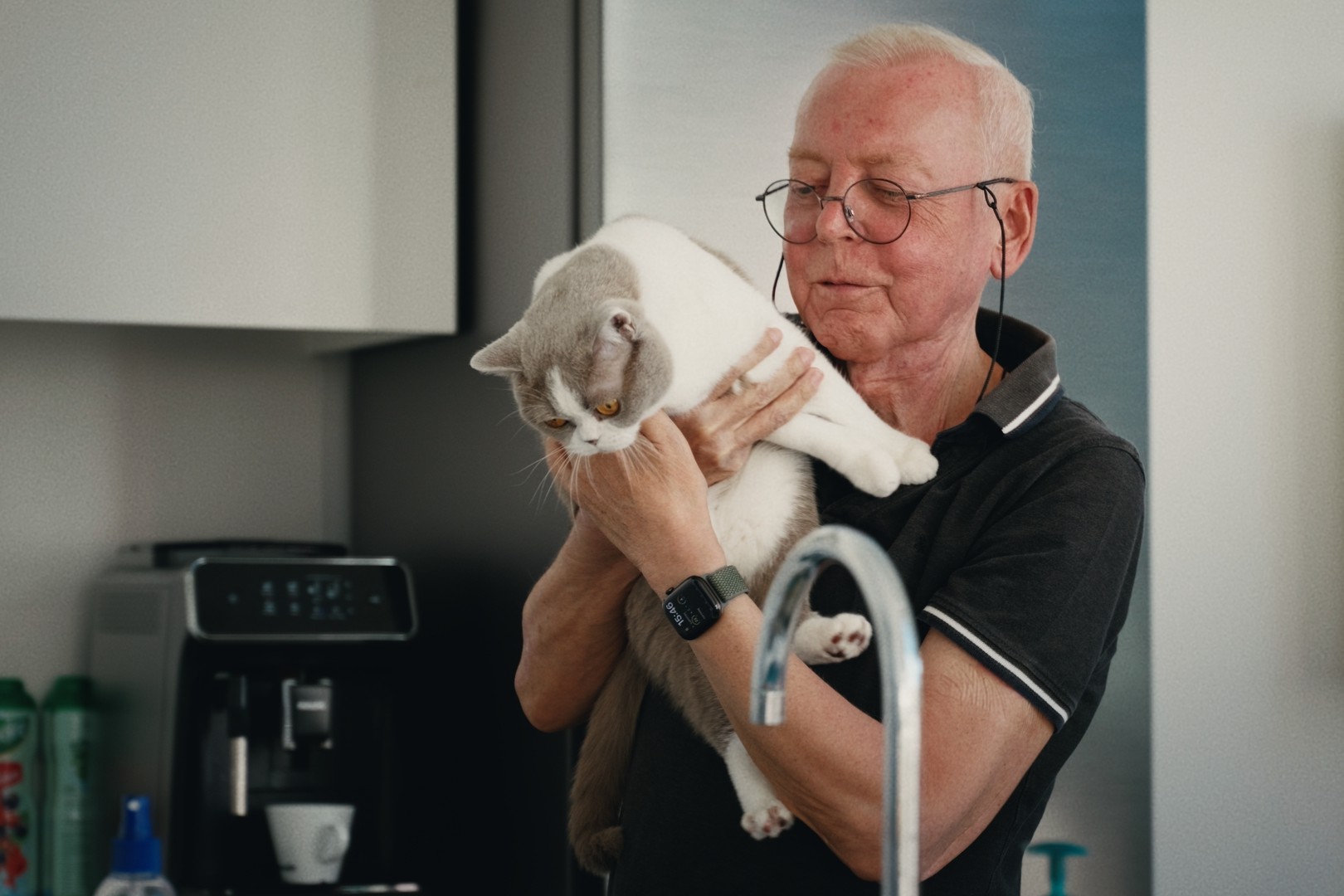
He tries to enjoy what is still possible: a good film, time with his cat, small moments at home. Photography was always an important hobby, but going out to take pictures is no longer possible. “People often say you should try to enjoy the good moments. But you can’t do much when you’re this weak. I just try to enjoy the things I can still do.”
His story illustrates why quality of life must be an essential part of how cancer care is evaluated. Survival and tumour control matter, but they don’t tell the whole story. The ability to to speak, swallow, eat, sleep and take part in social life is also an outcome of great importance to patients.
From patient to co-founder of SmakSmak
As early as his first diagnosis in 2015, Eric felt the need to share his experiences with other patients. He asked his psycho-oncologist whether there was a peer support group for people with mouth cancer. He was looking for support himself, but he also wanted to help others find their way after a diagnosis. No such group existed at the time.
Years later, it emerged that Viviane Vermeire, now chair of SmakSmak, had been asking the same question. By then, there were also doctors willing to back a peer support initiative. Eric got involved, and so helped lay the foundations of SmakSmak, a support group for people living with and beyond mouth cancer.
The association gives patients the chance to share experiences, get information and find support from people who understand what they are going through. SmakSmak volunteers are present at hospitals in Ghent and Leuven, among others, where patients can talk to them during consultation hours. The association also organises information sessions and get-togethers.
“It’s nice to meet people. We often combine our information sessions with a meal. That way we can talk to each other, sometimes about the illness, but sometimes just about this and that.” That social side is no minor detail. For people who find eating and speaking difficult, gatherings like these can be particularly valuable.
Eric describes himself as someone who mainly works behind the scenes. Even so, his role in founding and running SmakSmak shows how patients can draw on their own experience to play an important part in supporting others.
“Doctors need to learn to recognise the warning signs”
Asked what he would like to pass on to others, Eric immediately returns to the importance of early diagnosis. “If you have pain anywhere in your mouth, throat or neck that hasn’t gone away after three weeks or so, get it checked. And if the symptoms persist, even after you’ve seen a doctor, keep looking for answers.”
He urges people with persistent, unexplained symptoms to seek a second opinion if necessary. “If you feel your GP, or even the specialist, isn’t taking you seriously, go to another specialist for a second opinion. I didn’t do that enough myself, and I regret it now.”
His message is not aimed only at patients, however. Healthcare professionals, in his view, carry an important responsibility too. According to Eric, more attention needs to be paid to recognising possible symptoms of mouth cancer and other head and neck cancers, among GPs, dentists and dental hygienists as well as specialists.
Head and neck cancer can present with symptoms that seem fairly harmless at first. A first examination also doesn’t always find anything, even when a tumour is already present. Eric experienced this himself at his second diagnosis. Greater awareness, timely referral and good collaboration between disciplines are therefore essential.
An early diagnosis can improve the chances of survival, and in many cases it can also mean less aggressive treatment. In head and neck cancer this is especially important, because extensive surgery and radiotherapy can have such a major impact on daily functioning.
Specialised care, without losing sight of the practical side
Eric also has clear views on how cancer care is organised. He supports concentrating care for complex head and neck cancers in specialised centres. At his first diagnosis, he deliberately chose a large university hospital, assuming that the doctors there would have more experience with this relatively rare cancer.
“I think it’s a very good thing that they’re now going to designate specialist centres where the expertise will be concentrated.”
His view is in line with recent developments in Belgium to organise care for complex head and neck cancers through reference centres and specialised radiotherapy centres. Good care for these cancers requires more than the expertise of a single specialist. Surgeons, oncologists, radiation oncologists, speech and language therapists, dietitians and other healthcare professionals need to work closely together, both during treatment and throughout long-term follow-up.
For Eric, though, specialised care also means paying attention to the practical and financial consequences of cancer. In his view, this side of cancer care deserves more attention. Besides their medical treatment, patients also have to cope with the day-to-day organisation of their care, the costs, and the impact on their family and social life.
“Don’t just live with it”
Eric speaks openly about his illness, even now that he knows a cure is no longer possible. Above all, he wants to spare others the same long road to a diagnosis. He also wants greater understanding of the lasting consequences of head and neck cancer.
His story underlines that better cancer care can make a difference at many points: when someone first visits their GP with unexplained symptoms, when specialists work together to reach a diagnosis, during treatment, and in the years that follow. It also shows that patients themselves have an indispensable voice in that process.
By sharing his experiences and co-founding SmakSmak, Eric is trying to make that voice heard for others too.
His most important message remains simple:
“Don’t just live with symptoms that won’t go away. If you feel something isn’t right, take that feeling seriously and do something about it.”
To see and hear Eric, watch part of the interview in this video.