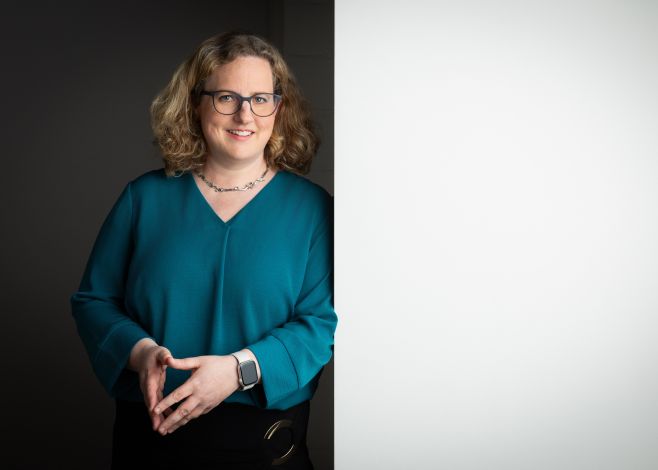
Lung cancer remains the leading cause of cancer-related death in Belgium, yet there is currently no organised population screening programme. The ZORALCS study is a Flemish pilot study on lung cancer screening, conducted across six municipalities in the south-eastern outskirts of Antwerp (the region called Zuid-Oost Rand Antwerpen, hence the name). As an implementation study, it not only examines the outcomes of screening, but also explores how a future population screening programme could be organised in practice. “If we were to introduce a population screening programme across the whole of Flanders tomorrow, we should essentially be able to copy and paste the process,” says Prof. Dr Annemiek Snoeckx, Associate Professor at the University of Antwerp, Head of Radiology at UZA and principal investigator of the study.
Participation is higher than expected
The ZORALCS study was launched in March 2025. A total of 25,883 residents aged 55 to 74 received an invitation letter. Of these, 5,272 (20%) logged on to the recruitment platform and 4,874 completed the questionnaire to assess their personal risk of lung cancer. In the end, 1,390 people were eligible, of whom 1,172 actually took part – 770 men (66%), 401 women (34%) and one non-binary person, with a median age of 66 years. All participants underwent a low-dose CT scan of the lungs.[1]
The first screening round has now been completed, and participants are being invited back for a follow-up examination one year after their initial scan.
Prof. Snoeckx looks back with satisfaction: “You can’t invite nearly 26,000 people all at once. So we worked municipality by municipality, and the process went surprisingly smoothly. One of the main conclusions is that participation was higher than we had expected based on comparable studies.”
The researchers also observed other striking differences. “We recruited fewer women than the other studies – only one-third of the participants are women,” says Prof. Snoeckx. “At this stage, we don’t yet know whether our region simply has fewer women at high risk, or whether we’re missing women who do meet the eligibility criteria but choose not to take part. That’s something we want to investigate further.”
It also appears to be more difficult to reach those who currently smoke. “We recruited more people with a history of smoking (64%) than people who currently smoke (36%),” she says. “In other large-scale studies, that split is closer to 50–50. So we will undoubtedly find it difficult to reach part of the population who currently smoke, sadly.”
Digital hurdles are not an obstacle
“Forty-eight per cent had secondary education as their highest education level,” says Prof. Snoeckx. This is a striking finding because taking part in the study required participants to complete several digital steps: they received a letter, had to visit a website and log in using itsme®.
The fact that they managed to reach this group is down to the good support provided. “We invested a great deal of effort in informing primary care professionals – not only GPs, but also pharmacists and other healthcare professionals. We also involved the Public Centres for Social Welfare (OCMWs) and digital support centres,” she explains. “Participants could also contact the study’s helpline or email address if they had any questions. We received 530 phone calls and more than 600 emails. That tells you we’re dealing with a generation that still uses the phone for actual phone calls,” she says with a smile.
Finally, simple communication also proved to be essential. The first invitation letter was modelled on those used for existing population screening programmes and contained quite a lot of information. “Although it was manageable, many people still find a letter like that challenging,” says Prof. Snoeckx. Inspired by a study on breast cancer screening, the team therefore sent greatly simplified reminder letters. “They simply contained the essentials: you are invited, with far less text and explanation. That approach worked very well for us too.”
“This shows that we tried in every possible way to achieve the highest participation rate we could. It wasn’t one single intervention – it was all of them together,” Prof. Snoeckx emphasises. Exactly how much each initiative contributed will require further analysis. At the same time, the researchers recognise that some groups will always be harder to reach. Under the current regulations, invitation letters for population screening programmes must be sent in Dutch. Prof. Snoeckx believes that communicating in other languages could make a difference for certain target groups. But she points out that the ZORALCS study was deliberately designed to operate within the existing legal framework. “Our study design has been developed so that it can be scaled up into a future population screening programme in Flanders.”
“All things considered, the overall outcome is positive,” she says. “We have reached a representative sample of the population.”
The results are representative
The first results match what the researchers expected based on other recent European studies. In 2.65% of participants, the screening result was positive. This means that an abnormality was detected that required further investigation straight away. Some of these cases will ultimately prove to be lung cancer, while others will not. In 5.46% of participants, a lung abnormality was detected that requires interim follow-up.
“These figures may not mean very much to people outside the field, but they are the percentages we expected,” says Prof. Snoeckx. “They are also consistent with findings from other studies. For example, there is a German study using the same approach that shows almost exactly the same results.”
At 5.46%, the proportion of participants requiring interim follow-up is much lower than in older screening studies, such as NELSON, a large Dutch-Belgian study launched in 2003. “This is important because these are people in whom an abnormality has been detected that isn’t suspicious enough to warrant immediate further investigation, but isn’t reassuring enough to wait until the next annual scan either. You want to keep that group as small as possible,” explains Prof. Snoeckx. “These people need additional scans and follow-up appointments. Not only does this increase healthcare costs, it also often causes anxiety.” This reflects the progress made over the past twenty years. Imaging has improved, software has evolved, and today we are much better at determining which lung nodules can safely be left alone and which require more prompt follow-up.
The fact that the Flemish results correspond so closely with those of other high-quality European screening studies shows that the programme is functioning as it should. Is the ZORALCS study representative? “Yes, absolutely.”
The only difference from other screening programmes lies in how ‘incidental findings’ are handled. In 13 participants (1.1%), the scan revealed an abnormality outside the lungs for which further investigation was recommended. “We only report major abnormalities that would be ethically difficult to ignore or that would require immediate treatment, such as a suspicious mass in another organ or lesions that could indicate a different type of cancer. Other studies also report additional findings for which it is unclear whether further follow-up offers any real benefit, such as calcification of the coronary arteries. That makes our 1.1% difficult to compare.”
The fact that the Flemish results correspond so closely with those of other high-quality European screening studies shows that the programme is functioning as it should.
The stigma around lung cancer remains widespread
Lung cancer screening is therefore both technically and organisationally feasible. But according to Prof. Snoeckx, the past year has also highlighted something else: the stigma surrounding lung cancer remains strong.
“Whenever our research was covered in the media, we received a few negative reactions from people asking whether we should really be spending money on people who smoke or used to smoke, because they brought it on themselves.”
That prejudice also weighs on people taking part in the screening programme. “They’re not only afraid of a possible diagnosis, they also feel they will be held responsible for their illness. They experience a great deal of shame.”
“Yet many people who currently smoke want to quit,” Prof. Snoeckx emphasises. The figures bear this out: 88.5% of participants who were eligible also took part in the TAMIRO-STOP smoking cessation programme integrated into the ZORALCS study. “But quitting smoking is simply very difficult. Smoking is an addiction, not a choice. Society sees it differently, though. If someone says, ‘I have lung cancer’, the first question is often, ‘Did you smoke?’ But if that same person says, ‘I have liver cancer’, people are much less likely to ask, ‘Did you drink? Are you an alcoholic?’”
For Prof. Snoeckx, this is one of the study’s key lessons. Lung cancer screening is not just about early detection, scans and statistics. It is also about how we view people at increased risk of lung cancer and how, as a society, we deal with illness, blame and responsibility.
Smoking is an addiction, not a choice. Society sees it differently, though.
What happens next?
There is still a great deal of important analysis to be done. The first results show how many participants had an abnormal scan, but that is not the whole story. After all, a suspicious abnormality on a scan does not automatically mean lung cancer. Conversely, someone may receive a reassuring scan result and still develop lung cancer several years later. That is why the researchers plan to continue following the participants over the coming years and link the data with the Belgian Cancer Registry. This will allow them to determine how many cancers were detected through screening and how many developed despite screening or were missed altogether. That may sound straightforward, but linking these datasets requires strict privacy procedures, and Cancer Registry data for a given year only become available two years later. It will therefore be some time before those results are available.
Further policy research is also under way. The Belgian Health Care Knowledge Centre (KCE) previously concluded that targeted lung cancer screening for people who smoke or used to smoke could be cost-effective in Belgium, based on older research data.[3] “Given the way our study has been designed and the data we now have, that cost-effectiveness analysis is only likely to produce even more favourable results than it did at the time,” says Prof. Snoeckx. Meanwhile, a new KCE study is planned to assess how much a population-based lung cancer screening programme would cost and what capacity would be required in terms of staffing and organisation.
Continued follow-up is not guaranteed
One of the biggest challenges will be ensuring that participants keep coming back. “We see the same thing in other studies. People take part, receive a reassuring result and think: once is enough. I don’t have cancer. That’s the end of it. But that’s not how it works. We need to be able to follow the entire cohort of 1,172 participants over several years.”
However, the financial future of the ZORALCS study has not yet been secured. The second screening round is now under way, but the researchers will need to secure additional funding for the rounds that follow. Is there a risk that the study could end prematurely because of a lack of funding? “Absolutely, but we will do everything we can to make sure that doesn’t happen.”
The challenge is not just gathering more data. Equally important is deciding when there is sufficient evidence to support a policy decision. Several European countries have already introduced a national screening programme or are preparing to do so. “Here in Belgium, the government has still not indicated what additional information is needed before a decision can be made on introducing an organised population screening programme,” she says. “Nor does it help that there is still no formal European recommendation for organised lung cancer screening.”
At the same time, Prof. Snoeckx warns that delays will have consequences. The longer an organised screening programme is delayed, the greater the likelihood that opportunistic screening will become more widespread. This involves people undergoing screening outside of a controlled programme, which threatens to undermine the very benefits that make an organised, population-based screening programme so valuable. “It’s always a bit ambiguous. On the one hand, you want to shout from the rooftops that lung cancer screening works and is important. But encouraging opportunistic screening is the last thing we want,” she says. “Then you end up screening the wrong people, with no quality control or structured follow-up.”
The initial results are in. The question now is what next step Flanders is prepared to take.
The longer an organised screening programme is delayed, the greater the likelihood that opportunistic screening will become more widespread.